
State deploys NYS in race to plant one billion trees
NAIF RASHID AND CHRISTINE CHERYL
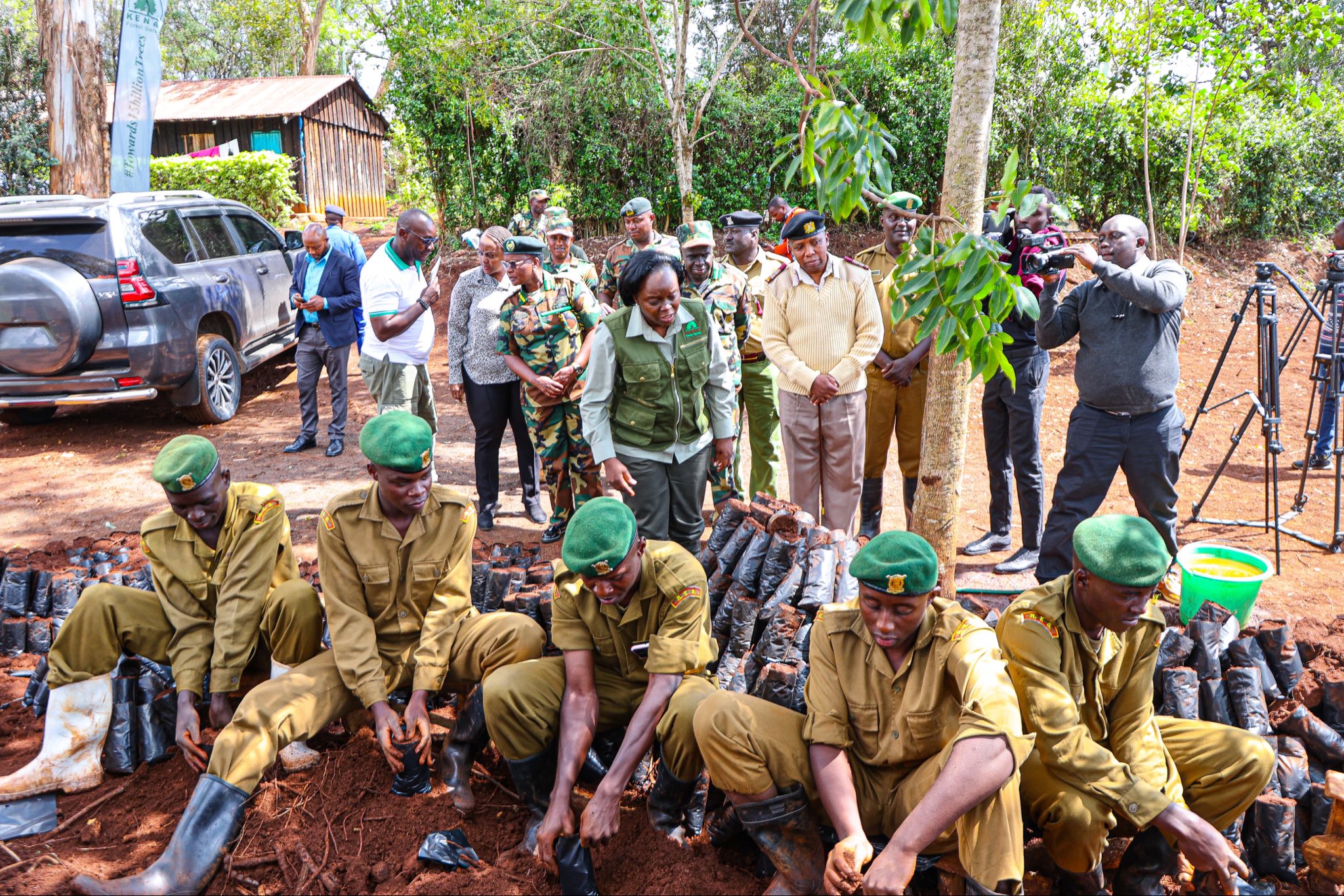
The Government has stepped up its national tree-growing campaign by deploying National Youth Service (NYS) officers to forest stations across the country, in a renewed push to meet Kenya’s target of planting one billion trees this year as part of the broader 15-billion-tree initiative.
During an inspection tour of Ngong Hills Forest Station, Environment, Climate Change and Forestry Cabinet Secretary Dr Deborah Barasa emphasized the need to scale up seedling production to support the ambitious national goal.
She emphasized that nursery operations are the backbone of the campaign, linking tree planting directly to climate resilience, green economy growth, and environmental restoration.
“When we are restoring our ecosystem and planting trees, we are looking at climate resilience, green economy, and environmental restoration, and also creating green jobs. Right now in Kenya, we have more than 363 million seedlings. We are calling on Kenyans to go and plant,” Dr. Barasa said.
The CS noted that while seed harvesting has improved, propagation capacity remains the main bottleneck; to bridge this gap, the Ministry is partnering with NYS to provide manpower and logistical support.
“For us to achieve a one billion seedling target within the country, we need human resource capacity, space, potting bags, seeds and water. That is why we are working with NYS,” she explained.
Ngong Hills Forest Station has already raised its production goal from 1.3 million to two million seedlings, 70 per cent of which are indigenous species earmarked for forest rehabilitation.
The station, which sits on five acres and has access to a borehole, has been designated as a demonstration site for other regions.
Regional Forest Conservator Joyce Nduku confirmed that similar preparations are ongoing in Karura, Ngong Road, Loitoktok and Namanga forest stations, all under the Nairobi Conservancy.
“This site was chosen as a demo because it has most of the facilities required. As potting continues, seeds from KEFRI are being supplied so that by the time numbers are reached, germination will already be underway,” she said.
At Ngong Hills, 29 NYS personnel are engaged in potting and nursery management.
Assistant Superintendent Hassan Mohammed, who supervises the team, highlighted the dual benefit of the initiative: supporting national conservation goals while equipping young people with practical skills.
“We thank the President for giving us the opportunity to work with Kenya Forest Service. The youth are learning. In case they are not employed by the government, they can find a job,” he said, noting that the team can pot up to 10,000 seedlings per day under favorable weather conditions.
Patrick Mutie, an NYS recruit from Kitui County, described the programme as a pathway to employment and career growth.
“It gives us a chance to get a job and to be promoted,” he remarked.
Dr. Barasa assured that stakeholders are being involved in propagation efforts and clarified that temporary structures erected at forest stations are solely for nursery operations.
She reported that monitoring systems indicate an 80 per cent survival rate of planted seedlings, while satellite imaging has recorded natural regeneration of up to 300 million seedlings in the last three years.
With the long rains approaching, the Ministry is urging citizens to plant at least 10 seedlings per month. Each seedling retails at approximately Sh15, making the target accessible to households nationwide.
“We believe that if each forest station meets its target and Kenyans participate fully, we will achieve our one billion goal this year and remain on track with the 15 billion tree campaign,” she reaffirmed.
The deployment of NYS officers represents a strategic move to accelerate Kenya’s conservation drive, ensuring that seedling production keeps pace with ambitious planting targets.