
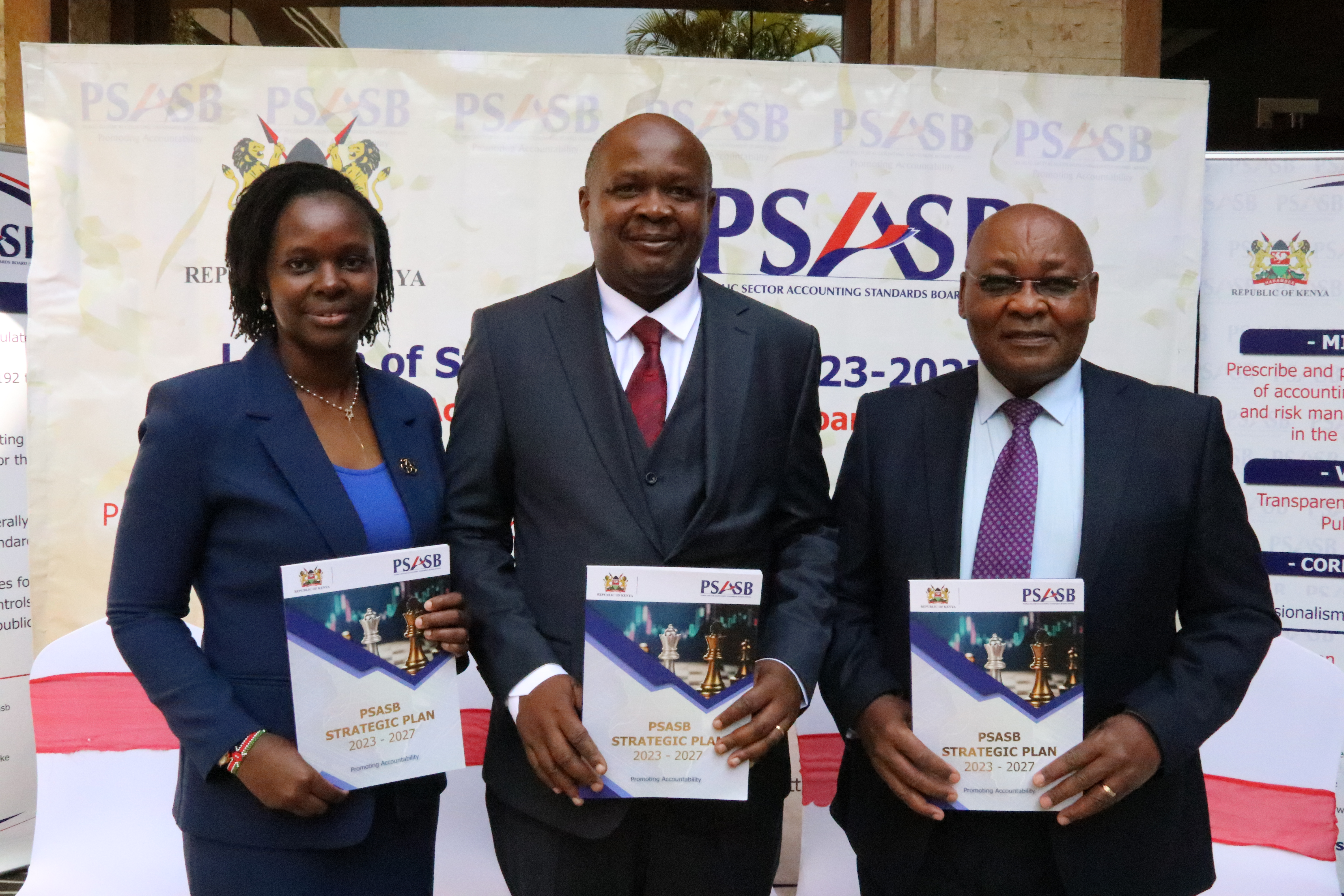
PSASB unveils Strategic Plan to promote transparency, accountability in the Public
MyGov Reporter
The Public Sector Accounting Standards Board (PSASB) has unveiled its third-generation Strategic Plan for the period 2023/24–2027/28 which sets the stage for enhanced transparency, accountability, and financial governance across Kenya’s public sector.
Building on the achievements of its previous plans, the new framework aligns with the Kenya Vision 2030, the Fourth Medium Term Plan (MTP IV), and the Bottom-up Transformational Agenda (BETA) and re-affirms PSASB’s commitment to driving the country’s development goals, said PSASB Board Chair Pius Nduati.
Speaking during the launch of the Strategic Plan, the PSASB Board Chair said in collaboration with the National Treasury, PSASB has made significant progress in prescribing globally recognized accounting and internal audit standards.
These, according to Mr. Nduati include the International Public Sector Accounting Standards (IPSAS) issued by the IPSAS (Board), the International Financial Reporting Standards (IFRS) issued by the International Accounting Standards Board (IASB), and the International Professional Practices Framework (IPPF) standards from the Institute of Internal Auditors Global.
“These standards have been widely adopted by public sector entities, resulting in consistent and comparable financial reporting, which in turn has enhanced the effectiveness of audits conducted by the Office of the Auditor-General”, said Mr. Nduati.
The Board Chair further said progress has fostered trust with development partners, improved asset and liability management, and cultivated a culture of accountability across government institutions.
Nduati said that the Public Sector Accounting Standards Board (PSASB) is playing a critical role in supporting Kenya’s Bottom-Up Economic Transformation Agenda (BETA) by ensuring robust fiscal management and accountability in the public sector.
“Anchored on the five key pillars of agriculture, MSMEs, housing and settlement, healthcare, and the digital and creative economy, the BETA plan aims to lower the cost of living, eradicate hunger, reduce unemployment, improve fiscal performance, stabilize foreign exchange, and promote inclusive economic growth” the chairman said.
To align with these priorities, he said, PSASB continues to prescribe and promote accounting standards, implement internal audit standards, develop risk management frameworks and issue guidelines.
“These efforts collectively enhance fiscal discipline, accountability, and the strategic use of public resources, ensuring that the objectives of BETA are achieved efficiently and sustainably” the Board Chair said.
He said the Strategic Plan identifies four critical areas for reform which include: enhancing the quality and uniformity of financial and audit reporting, capacity development in financial reporting and internal auditing, monitoring compliance with prescribed standards, and building institutional capacity.
Central to these reforms, Nduati said, is the transition from cash-based to accrual-based accounting by public entities, which took effect from 1st July 2024.
This, he said, followed the Cabinet's approval of March 7, 2024 and the eventual gazettement of the transition vide gazette notice number 11033 dated 30th August 2024.
For the next five years, Nduati said, PSASB will see to it that all public sector entities fully transition from cash to accrual accounting.
Additionally, during the five strategic year period, PSASB will ensure the public sector entities adopt, as from January 9th, 2025, the Global Internal Audit Standards (GIAS), the IPPF's main component released by the Global Internal Audit Standards which PSASB supports and advocates for early adoption, he added.
The shift to accrual accounting and global internal audit standards, he noted are expected to revolutionize financial management and internal audit, enabling better decision-making, international comparability, and comprehensive financial reporting.
Nduati further said that the adoption of accrual accounting will also promote effective management of public resources and strengthen transparency and accountability in government operations.