
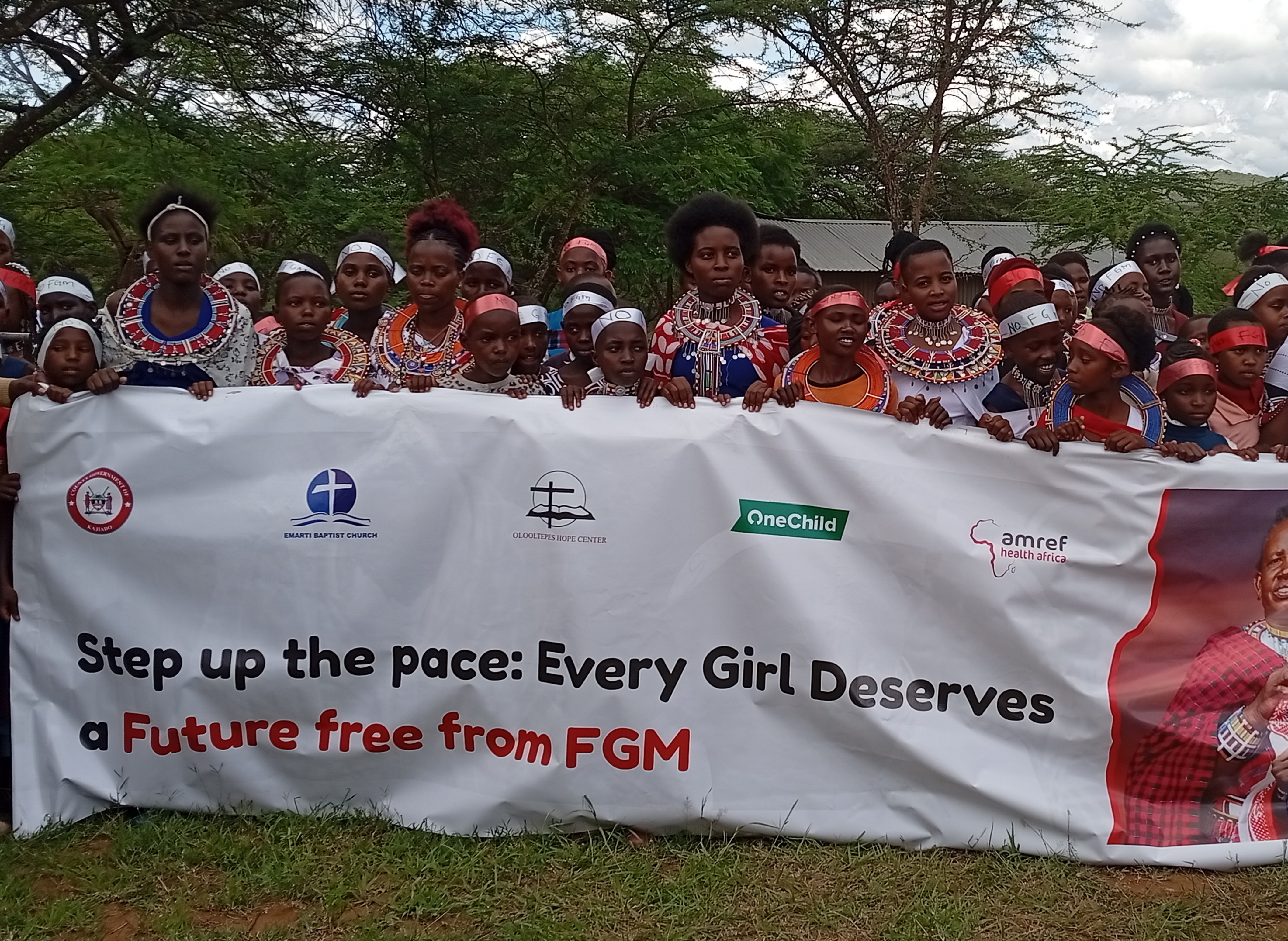
Maasai girls celebrate womanhood without FGM in groundbreaking ceremony
Rop Janet-KNA
For 12-year-old Faith Naserian, the fear of Female Genital Mutilation (FGM) had hanged over her for years.
In her Maasai community, it is expected, almost inevitable for girls to undergo the cut once they reach puberty. The practice of FGM is seen as a rite of passage, a transition into womanhood.
But Naserian has always had dreams of finishing school and pursuing a career in nursing. She knew that if she underwent FGM, her dreams would be dashed, as she would be forced to drop out of school and be married off.
When she heard about the community-led alternative rite of passage (ARP), the Grade 6 pupil knew it was her chance to break free.
“I was scared, I used to hear stories from older girls about the pain they underwent, and I knew that I did not want to go through that. When I heard that there was an alternative rite of passage, I knew that this was my chance to escape the cut,” she said.
With the support from her mother, Naserian joined the ARP programme at Emarti Primary School in Kajiado East.
The ARP, facilitated by Amref Health Africa in collaboration with local organisations and community leaders, is a community-led cultural right, alternative to female genital mutilation, that retains cultural rituals and ceremonies in the transition to womanhood, whilst replacing the harmful ‘cut’.
It retains traditional elements such as blessings, songs, and symbolic rituals, allowing communities to preserve their identity and abandoning the harmful FGM.
During the three-day session, over 700 girls aged between 10-17 years received training in life skills and decision making, sexual and reproductive health, child rights and gender equality, hygiene and personal care and education and career aspirations.
After the session, the girls were issued certificates that signified their transition into adulthood without undergoing the cut.
The programme also involved sessions for parents, traditional cutters and elders, where facilitators addressed cultural concerns, myths about FGM, and the legal implications of continuing the practice.
The ARP session culminated with a colourful ceremony, where the girls lit candles to signify their transition into adulthood before receiving blessings from the elders, affirming their transition to womanhood without the cut.
Ann Simaloi, one of the participants, expressed her joy after receiving blessings from her father and other elders.
“We are very happy to receive the blessings from the elders as it shows that they have accepted us as we are and that we are still accepted in our community even though we didn’t go through FGM,” Simaloi said.
Mary Mboi, a traditional ex-circumciser said she has now renounced the practice after seeing the harmful effects on the girls.
Mboi revealed that she used to cut the girls as a source of income and did not realise the physical and physiological harm caused by the practice until one girl, she cut almost lost her life after bleeding profusely.
“When I cut a girl, I used to charge Sh2000. I used to cut the girls as a source of income and also as part of our culture but when I saw the harm I was causing physically and emotionally to the girls; I knew I had to stop,” said Mboi.
According to Sharon Sipitiek, one of the teachers who undertook the girls through the training, the ARP model is very important as it gives an alternative for transition into womanhood for the girls.
She noted that embracing ARP would help reduce cases of school dropouts caused by teenage pregnancies, thus giving girls an opportunity to complete their education and pursue their dreams.
“In the Maa community once a girl is cut, she is seen as a woman who can freely engage in sexual activities. This has contributed to the high rate of teenage pregnancies which has resulted in many girls dropping out of school,” the teacher said.
Amref Health Africa Programmes Manager, Viola Ruto, said the inclusion of the community in the ARP model was crucial in driving social change.
She outlined the gains made by the introduction of the community –led ARP in reducing female genital mutilation noting that the prevalence of FGM had reduced by 24 per cent in the region, dropping from 80.8 per cent before the implementation of ARP programmes to 56.6 per cent in 2019.