
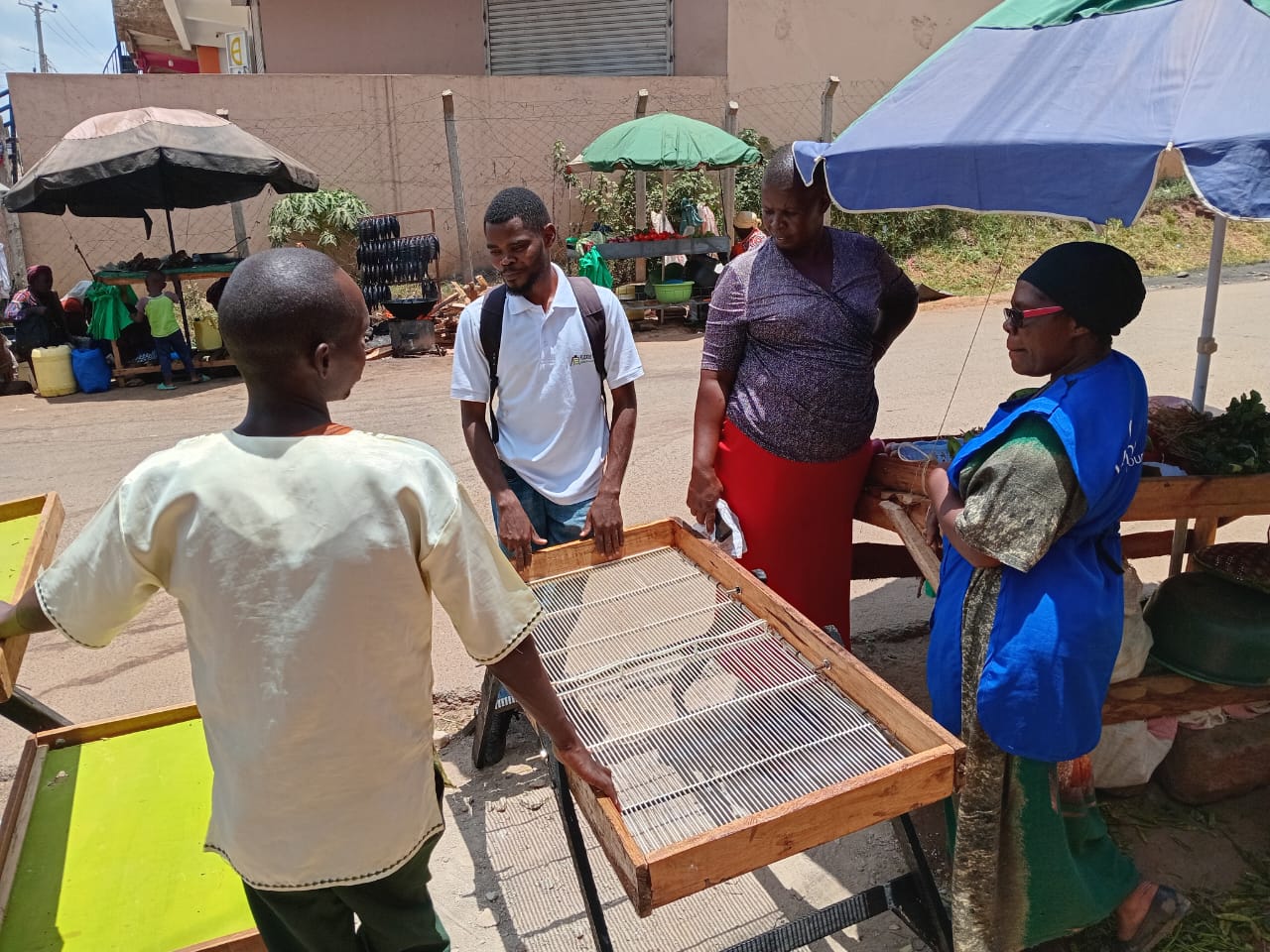
Engineering student innovates portable stalls for mobile vendors
GLORIA ASASHA-KNA
Starting a stall business requires careful planning, a strong understanding of the market, and a commitment to providing exceptional customer service.
Perhaps for this reason, a mechanical engineering student at Masinde Muliro University of Science and Technology (MMUST) has invented a unique collapsible structure that vendors can use to display their groceries.
In an interview, Kaguru Njoroge Muchina, the pioneer of Flexi Stalls, explains that these new structures are made of wood for support and partitioning, as well as metal for the grills that hold the goods.
“Compared to other grocery kiosks, Flexi Stalls are more hygienic, presentable, and portable, making them efficient and reliable for mobile vendors,” he observes. The stalls are priced between Sh1,500 and Sh3,500, depending on size.
Muchina says he started the business with a capital of Sh100,000, which he obtained through a seed fund from his former school under a program known as “Aspire.”
This financial support enabled him to launch the business. He describes his venture as vision-driven and looks forward to expanding it once he attains financial stability after completing his studies.
Muchina currently has no employees but works with fellow students who volunteer their time to help him. He recalls that the idea started as a school project, which gradually evolved into a business after consultations with the relevant authorities.
“Being a new product in the market, there are challenges associated with it. Even though it is a good and reliable structure, many people have yet to embrace it,” he says.
“They are used to traditional wooden kiosks and polythene coverings and are hesitant to try something new,” he adds.
Since launching the business, he has made only a few sales, but customer feedback has been positive and encouraging. To attract and retain customers, Muchina offers flexible payment options.
For those unable to pay upfront, he rents out the stalls at affordable rates based on demand. Additionally, he provides delivery services, ensuring that customers receive the stalls and later collects them after use.
However, despite their flexibility, the stalls are heavy and cannot be transported over long distances, which limits their market reach. “This is a major challenge in terms of transportation and marketing since moving the stalls over long distances requires financial resources,” he explains.
To address this, Muchina has developed a marketing strategy where he takes pictures of the stalls, prints them, and uses them for advertising.
“Although this method helps, it is not entirely effective because many people prefer to see the actual structure and understand how it works rather than just hearing about it,” he adds.
Among other issues such as lack of electricity, inadequate funds, inadequate manpower, expensive cost of raw materials and the fact that he is a student, are the major limitations for him.