
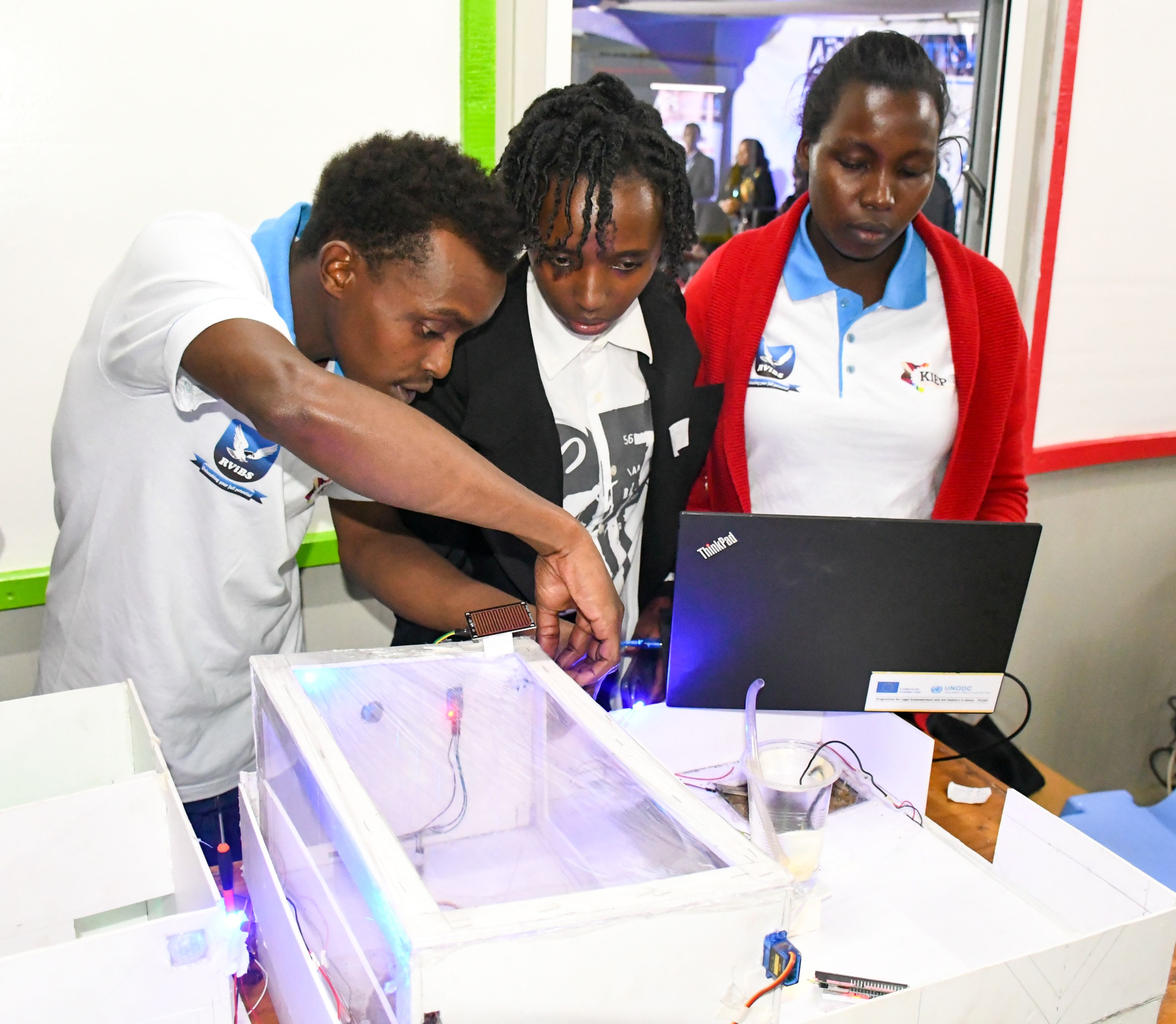
Rift Valley Institute of Business Studies learners unveil smart farm management system at expo
DENNIS RASTO-KNA
Imagine using an Internet of Things (IOT) technology that ensures that watering, temperature, lighting, humidity, air quality and soil moisture in a farm are perfect for plants to thrive?
This is a new farming innovation mooted by three students from Rift Valley Institute of Business Studies, (RVIBS) which promises and delivers just that.
“The innovation is a system that monitors a farm by accurately regulating the conditions best suited for the particular crop. It consists of a set of sensors and modules which collect data and trigger the system to control the farm and ensure proper agronomical conditions,” says Ms Mercy Wanjiru, one of the brains behind the innovation.
The other innovators of this system which was showcased during the recent RVIBS Tech Expo are Mr Charles Munyora and Ms. Gladys Daisi.
At the same exhibition Ms. Susan Muthami and Mr. Martin Kyalo explained to their audience workings of a security system that uses Global System for Mobile Communication (GSM) and guards against theft, toxic gas leaks, fires, intrusion and prying in residential premises.
Ms. Muthami said their innovation was inspired by the fact that security is one of the most important aspects for a home or a business owner whether he is away or at home.
There is nothing reassuring for one to know that his or her property is secure and intact, she said.
Mr Kyalo explained that the automated anti-theft system notifies the owner when there is an intruder in a home since it is fitted with motion detectors and sensors which send a message to the mobile phone or laptop computer of the owner.
The three students, all who are studying Internet of Things (IOT) and Robotics at RVIBS are beneficiaries of the Sh6.5 billion (50 million dollars) World Bank Funded SKIES (Strengthening Kenya’s Innovation Ecosystem) scholarship program.
SKIES, which is being implemented by the Ministry of Investments, Trade and Industry through the State Department for Industry aims to enhance the innovation ecosystem infrastructure by building the capacity of 13 Kenyan intermediaries such as incubators, accelerators, and technology boot camp providers.
Through the Kenya Industrial and Entrepreneurship Project (KIEP), the program is supporting these intermediaries who also include eight universities and 500 middle level colleges in start-ups in developing and deepening their operational strengths and individual business models, ensuring operational sustainability, expansion and improved quality of services provided.
Mr. Munyora explained that the prototype they developed can help farmers in automating irrigation systems and tracking soil moisture content.
“Basically, we have configured the system to avoid over-watering or under-watering of crops. The system is also equipped with a rain sensor designed to switch off water pumps whenever it is raining. This is to avoid wastage and bolster conservation of water which is gradually becoming a scarce resource,” he elaborated.
Mr. Munyora is confident that the prototype they developed can automatically control conditions in a green house and enables a farmer to remotely monitor the situation as when temperatures soar it triggers ventilation systems to cool the facilities.
“Our initial trials have confirmed that it also checks air quality and guarantees appropriate aeration. When the temperatures plummet below unfavorable levels, it triggers a heating system automatically. If the green house is either too hot or too cold the farmer is notified,” the young innovator elaborated.
Mr. Munyora said the system enables farmers to control a greenhouse with the smart-phone through a user-friendly app which is easy to understand and operate. More so, farmers can log into their accounts and control the greenhouse from there or through SMS.
The farmer can choose to control the farm automatically, where the farm regulates itself according to the optimum conditions of the crops being grown.
Notifications are sent to the farmer through the app or SMS. On the other hand, it can be controlled manually where, for example, the farmer can set the temperature to 24 degrees or the soil moisture to a particular value.

Rift Valley Institute of Business Studies learners unveil smart farm management system at expo
The system also regulates humidity, temperature, soil moisture, air flow, light and pH.
Ms. Wanjiru noted that various factors impact the environment inside a greenhouse, with heat, humidity, light levels, and ventilation among the main ones. The right combination, she added, helps maximize the yields. For instance, the more efficient the air circulation is, the more productive the plants will grow.
“Fine-tuning them manually is close to impossible. Yet, using IoT in a greenhouse environment and implementing the system properly can assist in automating and optimizing these factors for the ideal environmental conditions,” she added.
Additionally, the innovator indicated that the system comes with a package that enables farmers to get smart recommendations on their farm through analysis of the data provided. This, she said, is to boost the quality of produce as the conditions of the farm will be optimized.
One positive aspect about the innovation is that it factors in that farmers are extremely busy people and do not want complicated lives.
“The farmer can control the greenhouse easily with his or her smart-phone, through a user-friendly app, which is easy to understand and operate,” Ms Wanjiru says.
“I believe that farming in Kenya can reach its peak by embracing modern technology, where information and data analysis is readily available and accessible by anyone from anywhere. Local farmers rely too much on nature which is not as effective,” the tech-savvy innovator said.
The innovation is intended to make farming attractive to the youth, make the venture less labour intensive and less costly and conserve wastage of resources such as water and soil, Wanjiru said.
For Ms. Muthami and Mr. Kyalo their innovation is simple: that enables home owners to use the wireless home security system from wherever they are.
The system is fully controlled by the micro-controller which constantly monitors all sensors and if it senses a security threat the micro-controller sends a message to the user’s mobile through Global System for Mobile Communication (GSM) modem.
The anti-theft system has also an added function. It is equipped with a smoke sensor that detects gas leaks and noxious fumes in the house, particularly the kitchen and alerts the occupants through a buzz or a remote-controlled device to ensure safety.
The system is also equipped with technology that enables it to open a car garage whose details have been keyed into its data base and has provisions that only allow unlocking of main doors through swapping of cards.
Mr. Kyalo indicates that their innovation automatically triggers air conditioners when temperatures are inordinately high in a room, while it also prompts a heating system when it is cold. It also automatically switches on security lights when darkness falls.
The journey, Mr Kyalo says, has been littered with useful lessons. To perfect the idea, he worked with Ms Muthami who helped him to fine tune the innovation.
“There was a lot of intricate work involved. From developing our idea from scratch to seeing the device working. From putting up a great team and doing the work as well as rolling out test drives and overcoming the obstacles along the way has been incredible,” he said.