
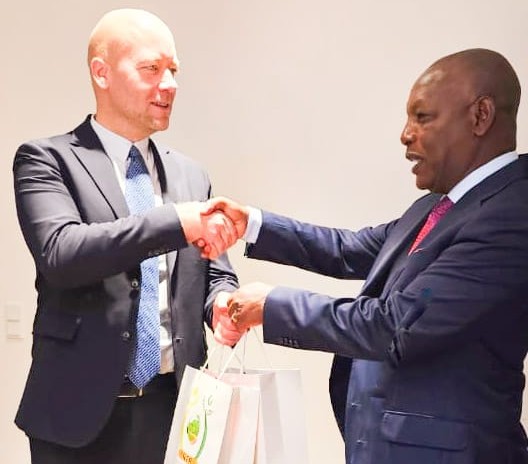
Agricultural sector gets boost from strategic partnership with Denmark
Dr Dennis Onkundi and Kawira Githinji
Kenya and Denmark have agreed to expand collaboration in the agricultural sector focusing more on food and feed safety, innovation and market access.
The partnership, according to Agriculture Cabinet Secretary Dr. Andrew Karanja, operates under the Strategic Sector Cooperation (SSC) Framework (2016-2026), aims to enhance agricultural production,
Dr Karanja said agriculture, under the Vision 2030, the Bottom-Up Economic Transformation Agenda (BETA) and the Agricultural Sector Transformation and Growth Strategy (ASTGS), is a key pillar of Kenya's economy and its transformation, contributing three per cent of its GDP and employing over 80 per cent of the rural workforce.
"In line with this, the Kenyan government has worked with global partners to strengthen food security, promote resilient agricultural practices, climate change and adaptability and ensure a stable future for the sector," he said.
The SSC initiative, launched in 2016, focuses on improving safety standards in key industries like horticulture and dairy.
Dr Karanja noted that the partnership also seeks to grow and expand the export potential of Kenyan agricultural products to international markets.
The project, expected to conclude in 2026, has already made notable strides in advancing quality standards in horticultural and dairy products.
At the invitation of the Danish Minister for Agriculture and Food, Jaco Jensen, Dr Karanja and a delegation made an official visit to Denmark to discuss progress and explore further areas of collaboration.
The two re-emphasized and took note of the significant progress made in earlier phases of the partnership particularly in food safety coordination, agricultural innovation, and regulatory frameworks.
The Cabinet Secretary emphasized the importance of extending the partnership beyond Phase III to implement the coordination mechanism for food and feed safety control mechanisms proposed and unlocking new market opportunities for both Danish and Kenyan agricultural products.
He also noted that such an extension would help enhance market access for Kenyan products, particularly in Europe and other international markets.
In addition to bilateral cooperation, the Kenyan delegation explored potential public-private partnerships (PPP) during their visit.
They met with the Danish Agriculture and Food Council and visited Denmark’s Food Nation, a quasi-government-private organization, focusing on areas such as the circular economy and waste management technologies, modern food storage, pork production technologies, and disease control mechanisms.
A particular area of interest was the adoption of Denmark’s advanced food storage solutions offered by Cimbria GSI company, which could help improve Kenya's food distribution systems, especially for perishable goods and cereals.
The delegation also explored innovative technologies in livestock farming, such as Denmark's pig farming practices and artificial insemination techniques by DanBred breeders who have done a lot of research into pig breeding and selection for litter size and feed utilisation efficiency traits which could assist in improving Kenya’s pork production and feed utilization at the farm level.