
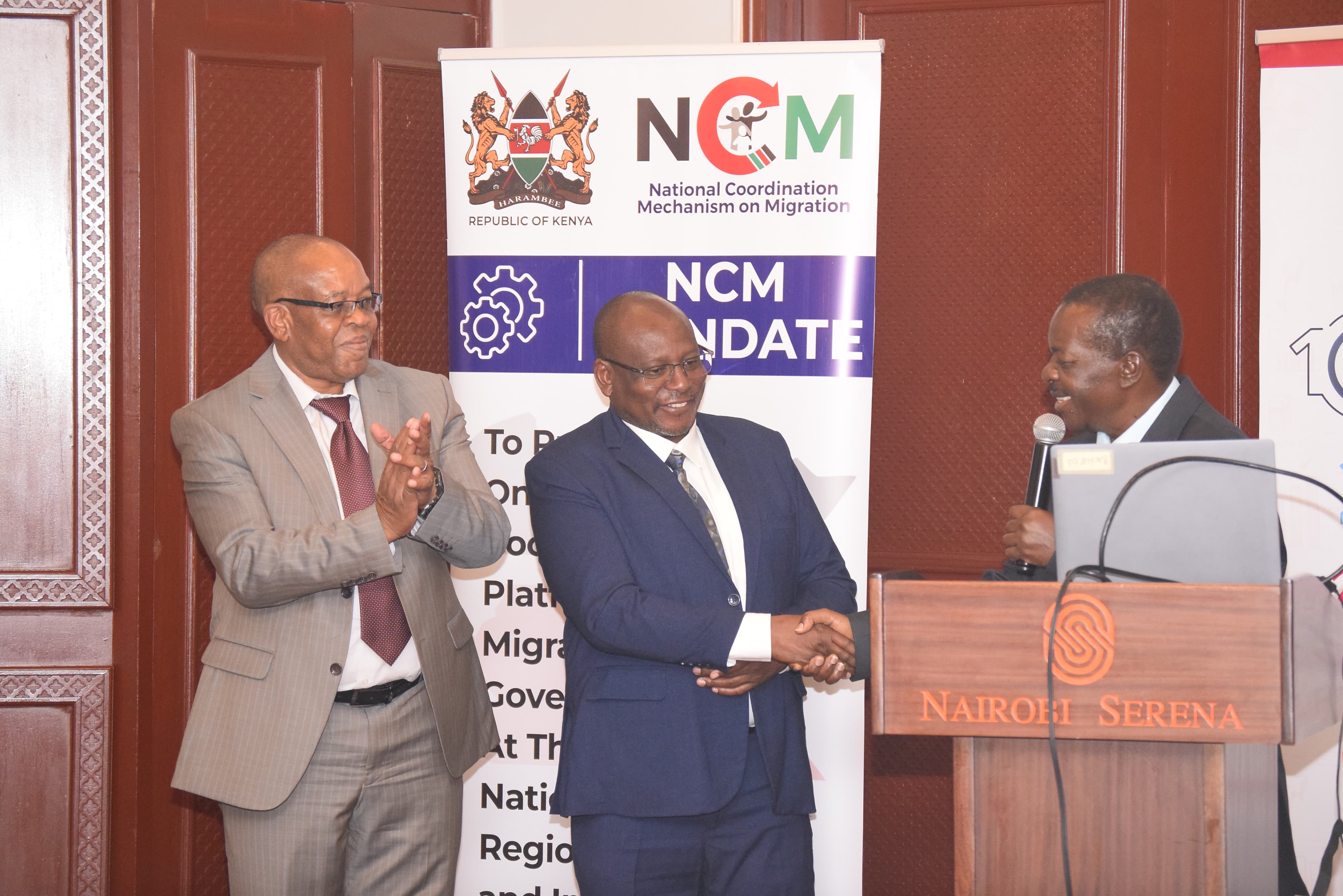
KNBS unveils committee to enhance data management
Joan Ogolla-KNA
The Kenya National Bureau of Statistics (KNBS) has launched the Migration and Displacement Data and Statistics Technical Working Committee (TWC) aimed at improving the country’s ability to track and analyze migration trends.
This effort seeks to bridge data gaps and support evidence-based policymaking to drive national development.
Speaking during the launch at a hotel in Nairobi, Principal Secretary of State Department for Immigration and Citizens Service (PS) Julius Kibet in a speech delivered on his behalf by Director General National Coordination Mechanism on Migration (NCM) Dr. Dan Opon emphasized the need for accurate and timely data to shape migration policies.
The PS said migration remains under-researched due to data gaps and policy fragmentation. The
In collaboration with the Kenya National Bureau of Statistics (KNBS), the committee aims to harmonize data collection and analysis within a structured legal framework. This approach will enhance governance by providing evidence-based insights for policymakers, researchers, and the public.
“The whole-of-government approach is central to the TWC’s mission, fostering cooperation among government agencies, NGOs, and the private sector to build a robust migration data ecosystem. By addressing data fragmentation and ensuring transparency, the initiative will strengthen migration governance and support informed decision-making at all levels,” he said.
He acknowledged that as migration becomes increasingly complex and dynamic worldwide, there is a growing need for accurate, timely, and reliable data to guide decision-making and anticipate future trends for effective interventions.
"Through this technical working committee, we will collaborate across the entire data cycle from collection to analysis and dissemination ensuring critical information is accessible to policymakers, researchers, and the public. With KNBS's expertise, the NCM will gain a dynamic data-sharing platform that evolves with the shifting migration and displacement landscape,” he affirmed.
Kenya National Bureau of Statistics (KNBS) Director General (DG) Macdonald Obudho, in a speech read on his behalf by Director Statistical Coordination and Methods Benjamin Avusevwa, emphasized the importance of accurate and timely migration data in shaping economic and social policies.
The DG noted that migration plays a vital role in Kenya’s growth, making reliable data essential for policy formulation, Sustainable Development Goals (SDG) monitoring, and overall governance.
“One of the committee’s main priorities is addressing Kenya’s lack of a comprehensive system for tracking internally displaced persons (IDPs),” he said.
Obudho reiterated that KNBS is developing a national IDP sampling framework, which would improve data accuracy and support targeted policy interventions.
Additionally, he said the KNBS would focus on key migration indicators such as labour migration, remittances, skills transfer, and environmental displacement, ensuring Kenya aligns with global best practices in migration data management.
“To improve data quality and usage, the committee will implement strategic measures, including strengthening data collection through household surveys, border records, and administrative sources,” he added.
He said the committee aims to promote safe and productive migration policies that protect migrants’ rights while maximizing economic benefits.
"That committee will develop a migration sector statistics plan, establish guidelines for data compilation, and publish an annual migration trends report, which are designed to enhance migration governance and ensure data-driven decision-making,” he said.
The DG emphasized that the launch of the committee marked a significant milestone in Kenya’s migration data agenda, reinforcing the country’s commitment to data-driven policymaking for economic growth and social development.
Dr. Opon acknowledged that the newly established committee would collaborate closely with the Kenya Bureau of Statistics to ensure migration data is comprehensive and accurate.
The role of NCM in spearheading the TWC initiative, transitioning from a working group to a fully-fledged technical committee.
“This is a significant step in organizing and managing migration effectively,” he said.
He urged committee members to prioritize data collection, processing, and application, highlighting that migration policies should be rooted in accurate data rather than assumptions.
“This committee must foster a culture that embraces decision-making based on data. Through rigorous research and analysis, we can detect trends and challenges before they become critical,” he said.