
Kenya to reduce food imports with Sh598 billion irrigation initiative
WANGARI NDIRANGU- KNA
The Government will mobilize resources amounting to Sh598 billion to expand the area under irrigation by one million acres over the next 10 years in a bid to increase food production.
Under the 10-year National Irrigation Sector Investment Plan (NISIP), the government aims to fasttrack various strategies, including public-private partnerships, credit guarantees for smallholder farmers, and the promotion of corporate agriculture.
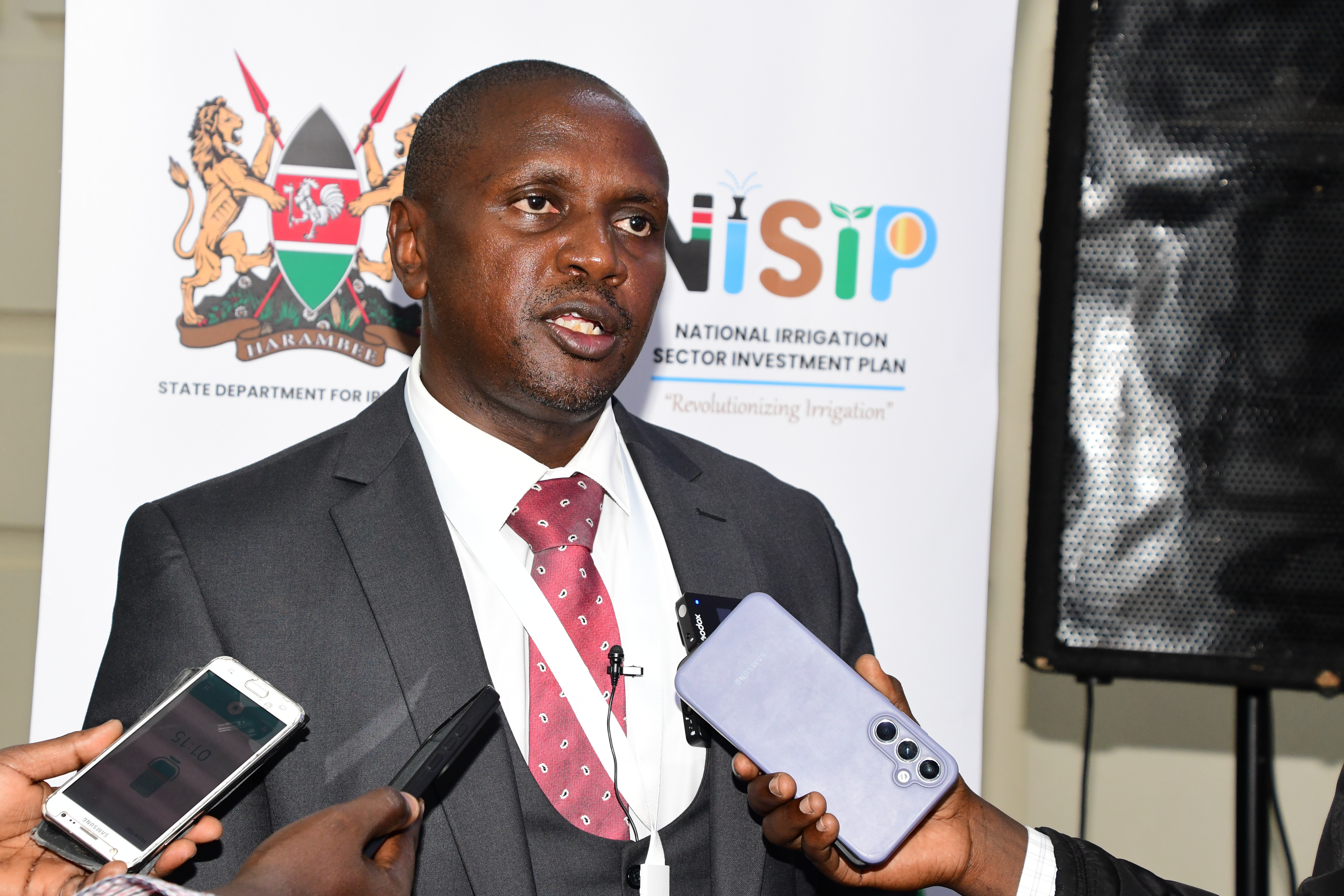
Speaking to the media during a pre-launch event, State Department of Irrigation Principal Secretary Ephantus Kimotho noted that increasing investment in the sub-sector would help make the country self-sufficient in food production, thereby reducing food imports.
Kimotho explained that 39 per cent of the required resources would be funded by the government and development partners, while 61 per cent would come primarily from the private sector.
“This strategy focuses on investing in irrigation for food and fodder production and will be guided by five investment pathways, enabling multiple financing sources and local initiatives that are strategically aligned with government goals,” he said.
Kimotho added that the country currently has 747,000 acres under irrigation, with 83,000 acres developed in the last two years, leading to increased production, particularly in the rice value chain.
“We initially we were doing 192,000 metric tonnes, currently because of the additional acreage and irrigation, mostly in public schemes, the rice production has increased by 293,000 tonnes, an increase of 50 per cent,” he said.
“By 2027, we want to increase the production to 440,000 metric tonnes and by 2032, one million metric tonnes,” he said.
The PS noted that the Mwea Irrigation Scheme has expanded from 25,000 acres to 35,000 acres and that the government is doing double cropping while ensuring that water is running and farmers taken care of the operational maintenance 100 per cent.
The government also plans to put 200,000 acres under irrigation in Galana-Kulalu despite perennial water shortage challenges. Kimotho said NISIP will be working with aggregators who have been having a challenge of getting the right quality and quantity.
“This plan we are trying to come up with is a framework of how we can create a linkage between the aggregators and the farmers so that the farmers can get contract farming and as a result farmers can get guaranteed income,” he said.
Vincent Kabuti, the Irrigation Secretary at the Ministry of Water, Sanitation and Irrigation said the goal of the investment plan was to revolutionize irrigation while making sure that farmers get increased earnings.
“We also want to provide a good working environment for the private sector so that they can put private capital into the irrigation space,” he said.
He explained that out of the five pathways that will guide the investment plan, the first one is the farmer-led irrigation which targets farmers who lead 250,000 acres of land accessible to water sources and another 100,000 acres without water sources.