
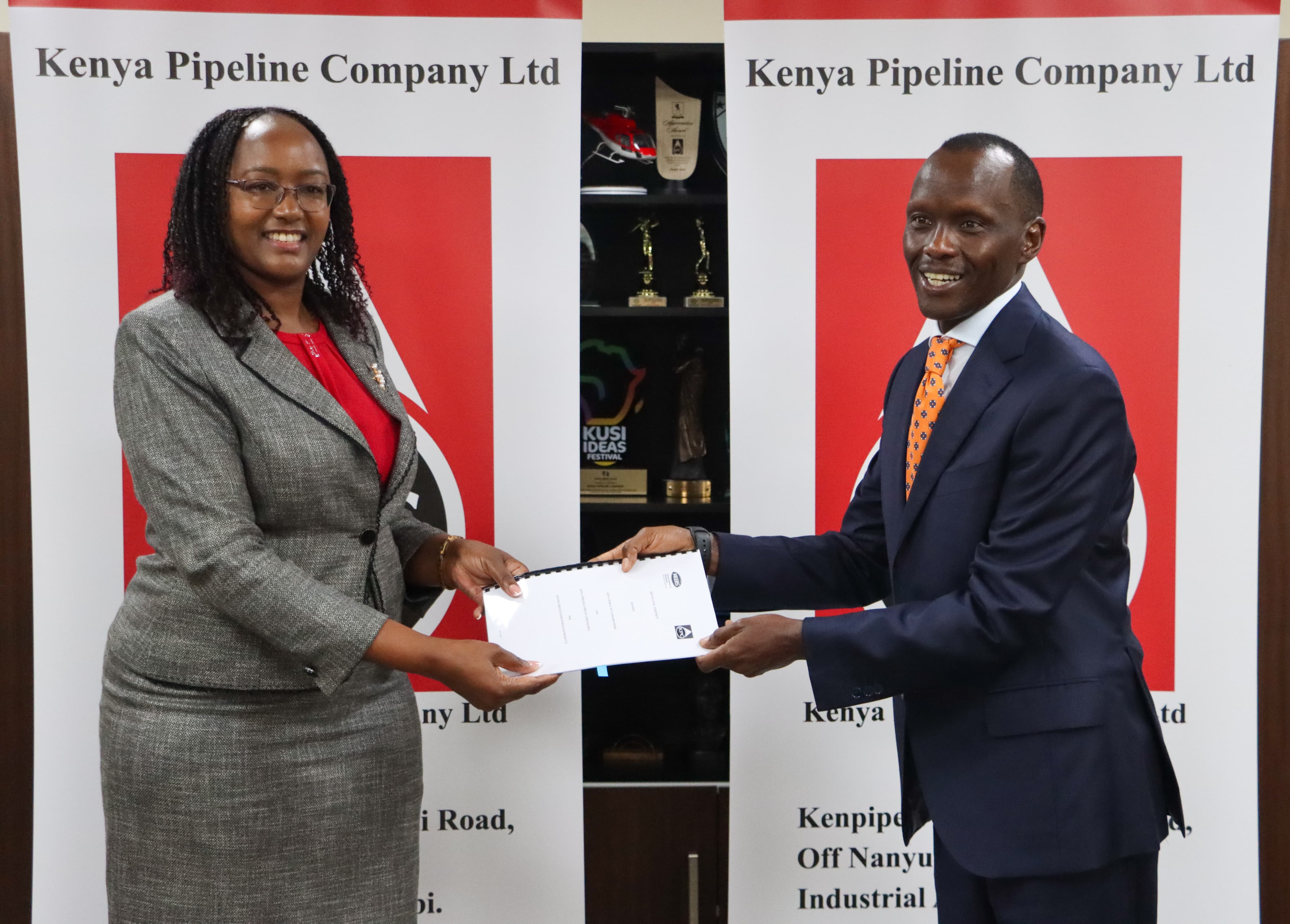
Kenya Pipeline, KEBS seal agreement to fast-track petroleum quality testing
Michael Omondi-KNA
The Kenya Pipeline Company (KPC) has entered into a strategic service level agreement (SLA) with the Kenya Bureau of Standards (KEBS) to facilitate the testing of petroleum cargoes entering Kenya.
The partnership, signed at KPC headquarters in Nairobi, marks a pivotal step in strengthening petroleum quality assurance and accelerating trade facilitation at Kenya’s key entry points, by testing petroleum products at KPC’s state-of-the-art laboratories, said KPC Managing Director (MD), Joe Sang.
The three-year agreement, valued at an estimated Sh45 million, is designed to transform the national fuel testing regime, by leveraging KPC’s network of seven technically equipped ISO 17025-accredited laboratories, six of which are dedicated to petroleum testing and one to environmental analysis.
Speaking at the signing ceremony the MD highlighted the transformative impact of the agreement, insisting that the collaboration between KPC and KEBS serves as a bold step towards deepening trust and efficiency in the country’s petroleum sector.
Mr Sang noted that having KPC’s seven accredited laboratories directly support KEBS testing will cut down fuel clearance time, promote transparency and strengthen Kenya’s reputation as a regional energy leader.
“Operationalizing this agreement following our ISO 17025:2017 accreditation ensures that every petroleum cargo entering Kenya is tested in full compliance with global standards,” he said, stressing that this will reinforce confidence among consumers, oil marketers and international stakeholders, a win for Kenya’s competitiveness as an energy, logistics and aviation hub.
Sang further said the laboratories, strategically located within major depots and at the Kipevu Oil Terminal in Mombasa, are equipped to deliver rapid, accurate, and internationally benchmarked results, using globally recognized ASTM and Energy Institute (EI) standards.
Concurrently, KEBS MD, Esther Ngari, expressed confidence in KPC’s testing capabilities, describing the collaboration with KPC as a landmark development in Bureau’s ongoing commitment to uphold and advance quality standards within the petroleum sector.
“We are confident that this partnership will drive efficiency, reduce logistical complexities and significantly contribute to the overall safety and reliability of the fuel supply chain,” she reiterated.
The SLA builds on KPC’s 2021 Strategic Plan to commercialize its laboratories and extend testing services to third-party entities, including oil marketing companies (OMCs). Previously, KEBS used to ferry samples to distant facilities, a process that incurred higher costs and longer delays.
With KPC’s labs now fully equipped and accredited, the testing cycle for petroleum products such as diesel, petrol, aviation fuels and lubricants will be completed in as little as seven hours, down from the previous 24 hours.
Sang said the agreement reaffirms the government’s broader agenda to foster synergy among state agencies, improve regulatory efficiency as well as promote trade competitiveness.
It also positions KPC as East Africa’s largest multi-site accredited laboratory network, capable of supporting Kenya’s growing energy demands while maintaining the highest standards of accuracy and reliability, he said.