
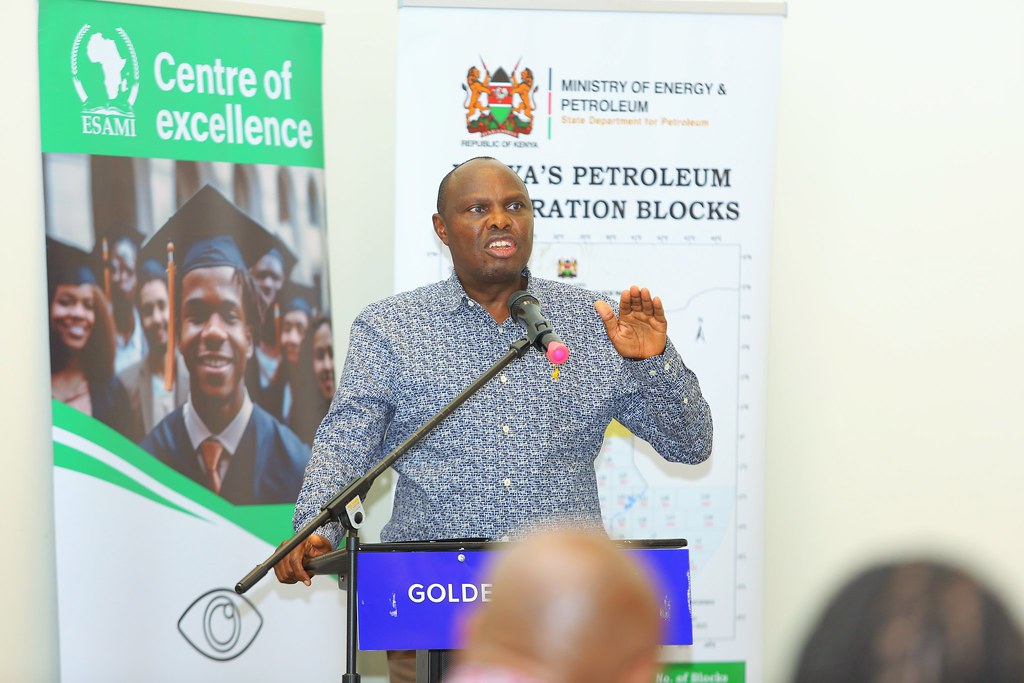
Head of Public Service urges civil servants to serve citizens diligently
Joyce Lutomia -PCO
A good civil service stands as the backbone of a just and prosperous society and places public interest at its core.
Head of Public Service Felix Koskei reiterated that good civil servants listen to the people they serve, seeking feedback and involving citizens in decision-making to ensure services meet real needs, saying good civil service is fair and inclusive.
“Services must be accessible and tailored to meet the needs of all, regardless of background, and that responsiveness is equally vital, problems must be addressed swiftly, efficiently, and thoughtfully,” he said.
He was speaking during the Advanced Project Monitoring and Evaluation (APME) Workshop for Executives in the Oil and Gas Industry facilitated by the Eastern and Southern African Management Institute (ESAMI).
Koskei said monitoring and evaluation are not just technical processes; they are governance functions. They are the lenses through which the Civil Service validates performance, tests assumptions, refining policy, and responds to emerging challenges.
“As the Head of Public Service, I view monitoring and evaluation not as administrative formalities, but as strategic imperatives that inform public value and policy relevance. Across the government, we must elevate M and E from a compliance exercise to a central pillar of how we design, implement, and assess our programmes. In the petroleum industry, this shift is particularly urgent,” he said.
The Head of Public Service added that the discovery and exploitation of petroleum resources must go hand-in-hand with mechanisms that guarantee accountability, foster inclusiveness, and safeguard the environment.
He said the State Department for Petroleum is at the heart of Kenya’s economic modernization strategy as it oversees the South Lokichar oil field development and supporting the expansion of national LPG usage and ensuring stable fuel supply and attracting upstream investment.
“These programmes must be executed with integrity, efficiency, and measurable impact. That can only be achieved through the kind of advanced monitoring and evaluation competencies you are here to develop,” Koskei said.
State Department for Petroleum Principal Secretary Mohamed Liban on his part urged government officials to continue enhancing their skills through training programmes to boost efficient service delivery to citizens.
“The State Department has implemented policy measures and legal frameworks to ensure sustainable growth of the oil and gas sector and encourage investors. Our commitment to transparency, efficiency, and fostering public and investor confidence remains unwavering, underscoring our dedication to continuous human resource development,” PS Liban said.
Kenya’s petroleum industry, both the upstream and downstream sectors, are recording significant developments. In the upstream sector, the government has ranked 50 exploration blocks based on their potential, aligning with global best practices to attract new investments.
Kenya has made oil discoveries in the South Lokichar basin (2012) and natural gas discoveries in Block 9 (Anza basin) and offshore Lamu.
PS Liban said the government is actively bringing in investment partners to fast-track these discoveries, particularly getting South Lokichar to the production phase.
He said having secured a strategic partner for the South Lokichar discoveries, the government is finalizing ambitious upstream regulatory frameworks to attract and maintain investment confidence, aiming for a robust regulatory regime for the sector.
In the downstream sector, the government has tapped the Government-to-Government (G-to-G) initiative for bulk petroleum product importation to allow Kenya’s oil marketers to trade in Kenya shillings.
This will significantly contribute to the stability of the Kenyan shilling against the US dollar by freeing up dollars for other sectors and curbing market speculation.
The PS said the government has removed VAT on imported Liquefied Petroleum Gas (LPG) to promote its adoption.
“To achieve 100 per cent access to clean cooking by 2028, we are investing in large-scale LPG adoption through multi-faceted strategies addressing the entire value chain,” he said.