
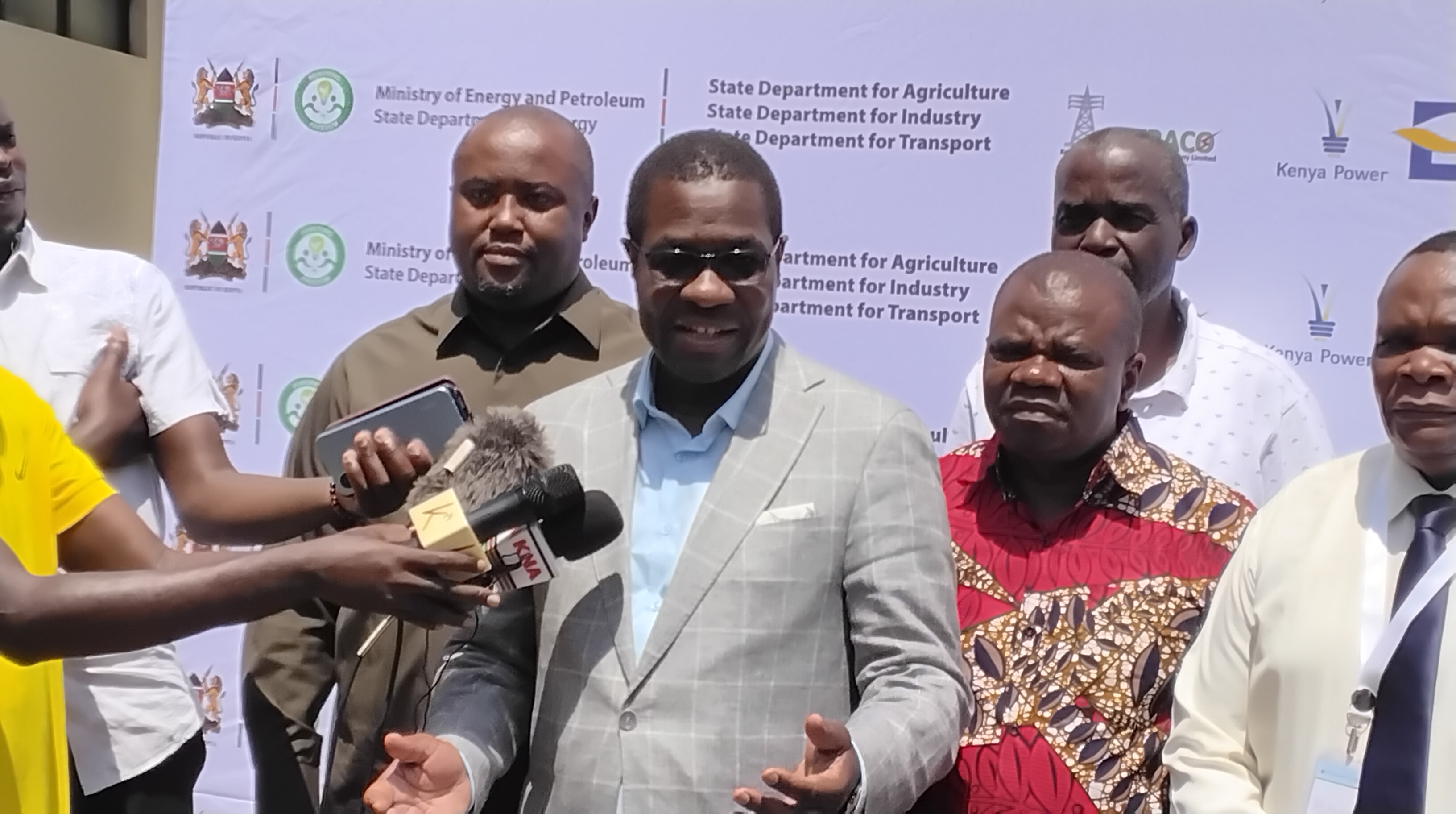
Government to scale up bio-ethanol production to meet growing demand
Chris Mahandara-KNA
The Government is scaling up co-generation and bio-ethanol connectivity, and access to clean energy by the year 2030.
Energy Cabinet Secretary (CS) Opiyo Wandayi said the government is rooting for diversification of Kenya's energy mix to meet the rising demand for power while addressing climate change concerns.
Co-generation, the simultaneous production of electricity and useful heat alongside bio-ethanol sourced from the sugar sector have been identified as some of the most sustainable alternatives to fossil fuels and biomass.
To achieve the target, the State Department for Energy, in partnership with the sugar sector has rolled up measures to scale up co-generation and bio-ethanol to help bridge the energy gap.
Wandayi said that despite producing 11.3 million liters of ethanol annually, the country is facing a growing demand for over 40 million liters per year, a gap that is met through imports.
He said that the demand is projected to rise five-fold by the year 2035, posing both a challenge and an opportunity for local production, he said.
According to the CS, currently the sugar industry has the capacity to generate 196 MW of electricity, which is underutilized, adding that with additional investment, the capacity could exceed 300 MW, providing a stable and clean energy source to support the country’s goal of achieving 100 per cent clean energy and electricity access by 2030.
Speaking in Kisumu during the Co-generation and Bio-ethanol Conference, Wandayi said the initiative was in line with the country’s efforts to meet Sustainable Development Goal 7, which aims to provide modern energy solutions for all while addressing climate change.
"We have set national targets towards this goal including universal access to electricity and clean cooking by 2030 to drive socio-economic transformation.
"In this manner we will also be achieving our national obligations to international frameworks such as the nationally determined contributions," he said.
To accelerate the development of these sectors, the government has already implemented initiatives such as the Feed-in-Tariff Policy introduced in 2018, encouraging investment in renewable energy.
Additionally, the Bio-energy Strategy (2020) and its action plan were being rolled out to foster the growth of bio-ethanol production.
"We are also in the process of revising the National Energy Policy, to take on board emerging local and international trends, and further align with the current government development agenda across sectors," he said.
To give impetus to the drive, the CS said plans are underway to develop a National Strategy for the Accelerated Development of Co-generation and Bio-ethanol Sectors.
Once in place, the ministry will establish a dedicated Co-generation and Bio-ethanol Development Committee to spearhead the sector.
The conference themed, “Co-generation and Bio-ethanol Production for a Greener Future,” sets the agenda for collective action by different sectors and multiple stakeholders, to overcome barriers and exploit opportunities for enhanced investments in co-generation and bio-ethanol industries.
"Our objective is to stimulate the growth of the sector, meet growing demand, ensure sustainable supply, safeguard local investments, and create employment, while fostering the wellbeing of stakeholders including small holder farmers and local industries," he said.