
Government to purchase one million bags of maize to replenish the Strategic Food Reserve
JOSEPH NG’ANG’A-KNA
The Ministry of Agriculture and Live stock Development projects that farmers in the country will produce an estimated 75.9 mil lion 50-kilogram bags of maize during the long rains season, based on the achieved acreage of 1.64 million hectares and an estimated average yield of 42 bags per acre.
Former Agriculture and Livestock Development Cabinet Secretary (CS) Dr. Andrew Karanja said the ministry anticipates that, cumulatively, annual production will reach 94.4 million bags, based on the projected total annual acreage of 2.71 million hectares.
“The past two seasons have been very favorable in terms of weather, government fertilizer subsidies, and input supply. T he food situation in the country is very positive,” Dr. Karanja said.
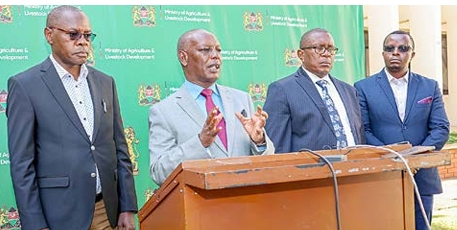
Speaking in Nairobi during a media engagement, the CS announced that the government has instructed the NCPB to purchase one mil lion 90-kilogram bags of maize for the strategic food reserve at a price of Sh3,500 per bag.
He explained that al though there is pressure to purchase the maize at higher prices, the ministry determined through careful analysis that the cost of production has slightly decreased.
In 2023, farmers were receiving government-subsidized fertilizer at Sh3,500 per bag, whereas in 2024, the price dropped by Sh1,000 to retail at Sh2,500.
Dr. Karanja said the pressure is also in balancing the price of maize and the cost of Unga, explaining that if the price of maize goes high, the same will apply to a packet of Unga which is currently retailing at average of Sh120.
“By the time we were announcing the price of Sh3,500, farmers were getting Sh2,800 from the market but the prices have started going up due to government interventions,” he said.
Dr. Karanja highlighted that about 6.3 million bags of beans are expected to be harvested by the end of December 2024 adding that this will bring the total stock of beans to 12.2 million bags of 50 kilo grammes by the end of December 2024.
“For wheat, we expect a harvest of 1.8 million bags at the end of December 2024. The challenge is that millers have not been buying wheat from the farmers very well but we are working with them to ensure that the farmers are able to get good returns from their pro duce,” said the CS.
Dr. Karanja said the rice balance sheet projection indicates the country will have a surplus of 2.7 mil lion 50-kilogramme bags by the end of December 2024.
The estimated production for 2024 is 3.29 million bags of 50-kilo gramme paddy rice from a total area of production of 35,496 hectares.
He added that the horticulture sector continues to show promise, with demand for fresh produce rising in international markets with the production of avocado projected to reach 622,600 metric tons.
“The sugar production in Kenya for the entire 2023/2024 crop season is projected to total 800,000 metric tons. We are now self-sufficient in sugar production and we have stopped imports,” the CS said.
Dr. Karanja said that tea production is projected to reach 600 million kilo grammes from 570 million kilogrammes of the previous year. This is attributable to the access by farmers to subsidized fertilizer and good weather.
“The income from tea is expected to cross the Sh200 billion mark for the first time,” Dr. Karanja said.
Under the Edible Oils Promotion Project, the CS said that a total of 556 metric tons of sunflower seed have been distributed to farmers in 2024 to cover over 200,000 acres estimated to produce 40,000 metric tons of edible oil.
He said that this project is intended to cut import costs by 50 per cent in five years. Other edible oils covered by the project include canola, coconut, sesame, and oil palm.
On the fertilizer subsidy programme, Dr. Karanja said that farmers have continued to receive fertilizer through the e-voucher system across the counties for various crops.
He explained that the Government through the National Cereals and Produce Board (NCPB) commenced procurement of 4.9 million 50 kg bags of fertilizer in 24th July 2024 for both planting and top dressing.
“Currently those who got the tenders to supply the fertilizer are delivering them to NCPB and the agreement is that we will have all the fertilizer in our stores by mid-January 2025 so that by February-March when the rains start, the farmers will be able to access the subsidized fertilizer,” said Dr. Karanja.
The CS explained that this comprises 3.3 million bags for planting and 1.6 million bags for top dressing. For the 2024 short rain season, 2,032,130 bags of various types of fertilizers have been re deemed by 486,213 farmers.
According to Dr. Karanja, farmers are com plaining because they are spending a lot of money to collect the fertilizer with some saying they are going for 200 or 300 kilometers since the NCPB stores are not very many and they are far away.
To remedy this, Dr. Karanja said that they are going to onboard other outlets like cooperatives in the coffee growing zones so that farmers can pick the fertilizer there.
“We are also onboarding a significant number of agrovets and agro-dealers and building their capacities to ensure that farmers can access the fertilizer near their area,” explained Dr. Karanja.