
Government plans to double milk production, boosting small-scale farmers’ incomes
JOSEPH NG’ANG’A-KNA
The Government has outlined plans aimed at doubling milk production in the country from 5.2 billion to 10 billion liters annually. T his initiative will boost small-scale farmers’ average monthly incomes to Sh56,000.
Agriculture and Live stock Development Cabinet Secretary (CS) Dr. Andrew Karanja stated that achieving these ambitious goals requires focused, collaborative efforts from all stakeholders to address challenges in productivity, value addition, and market access for milk and dairy products.
“Last year, the Ministry facilitated a key meeting between milk processors and President William Ruto to develop strategies for these goals.
"The discussions identified a six point agenda, including enhancing milk productivity and reducing production costs, promoting efficient bulking and cooling of raw milk, addressing tax barriers that hinder dairy growth, establishing a development fund to support the industry, and improving the quality and safety of milk and dairy products,” said the CS.
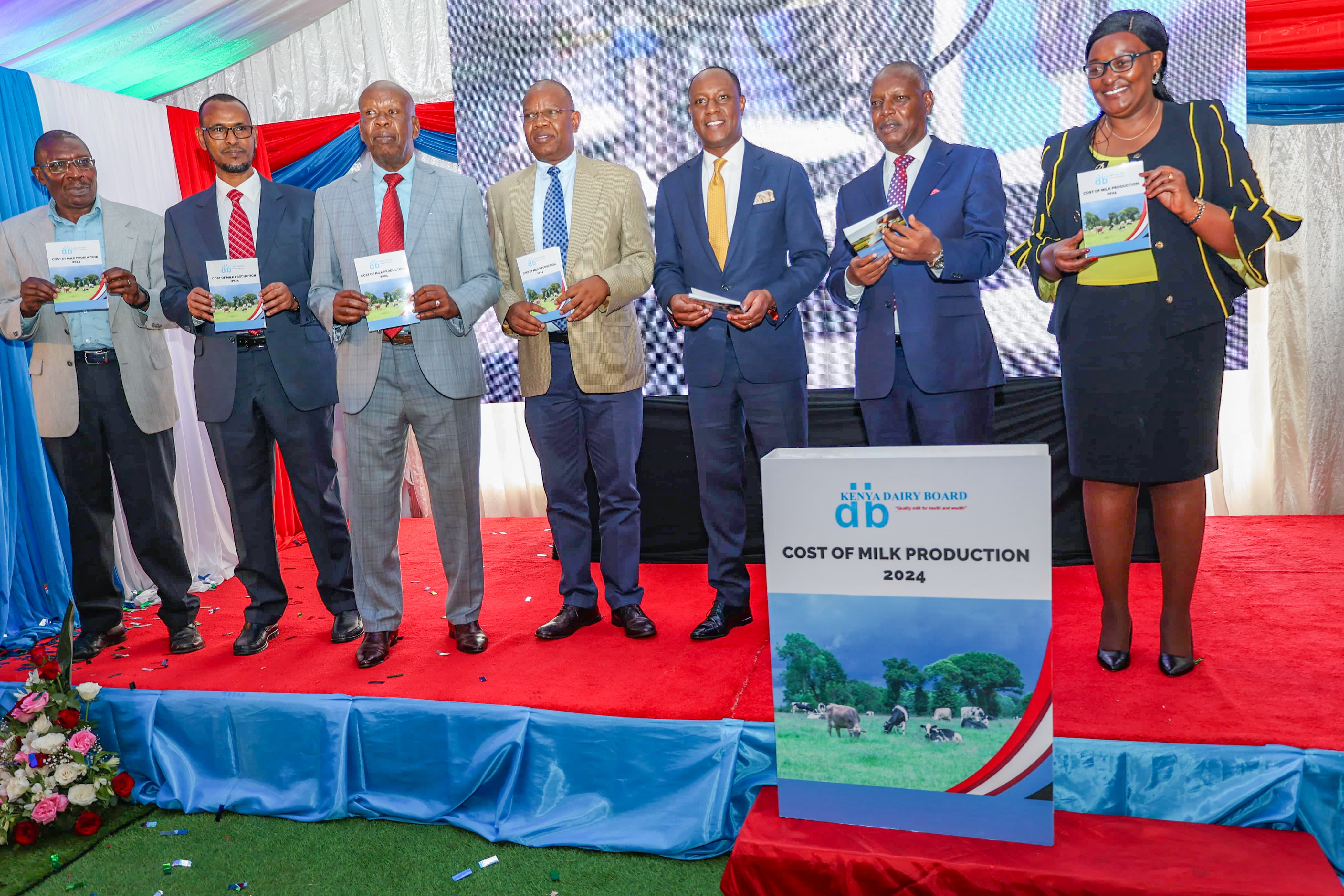
Speaking at the Kenya Dairy Board (KDB) head office during the launch of the Cost of Milk Production Study Report (2024), Dr. Karanja said the Ministry is advancing critical legal and regulatory reforms, including the Livestock Bill 2024, Dairy Industry Bill 2024, and the Veterinary Practice and Veterinary Medicine Bill 2024, to create a more supportive environment for the dairy sector.
“The Kenya Dairy Board recently established a national dairy regulatory laboratory, now ISO 17025certified, ensuring reliable testing of milk and dairy products. The Ministry aims to enhance the lab’s capacity for specialized contaminant testing and encourages stakeholders to use this facility to access domestic and export markets,” the CS said.
To support farmers, Dr. Karanja said that the government is procuring additional milk coolers to improve milk bulking, quality, and safety while fostering stronger contract farming arrangements. He said efforts are also underway to improve access to affordable commercial concentrates, quality fodder and superior genetics.
Dr. Karanja said the dairy industry is a vital socio-economic sector in Kenya, supporting in comes, employment, food security, and social status for many.
Annually, Kenya produces about 5.2 billion liters of milk, ac counting for 10 per cent of Africa’s and 35 per cent of the East African Community’s total production.
The CS highlighted that in 2023, milk received by the formal market rose by 7.4 per cent to 811 million kilograms, up from 755 million kilograms in 2022.
The value of this milk in creased by 13 per cent, reaching Sh40.5 billion, compared to Sh35.7 billion the previous year.
Dr. Karanja said according to the Economic Survey 2024, milk ranks as Kenya’s fourth most valuable agricultural commodity after tea, horticulture, and cattle sales, supporting the livelihoods of over two million small scale rural dairy farmers.
The CS explained that the recent study on the cost of milk production confirms that dairy farming remains profitable, with earnings of Sh9.8 to Sh13.9 per liter, depending on the production system.
“Despite challenges like high costs for commercial feeds, fodder, and labor, the profitability highlights dairy farming as a promising investment,” Dr. Karanja said.
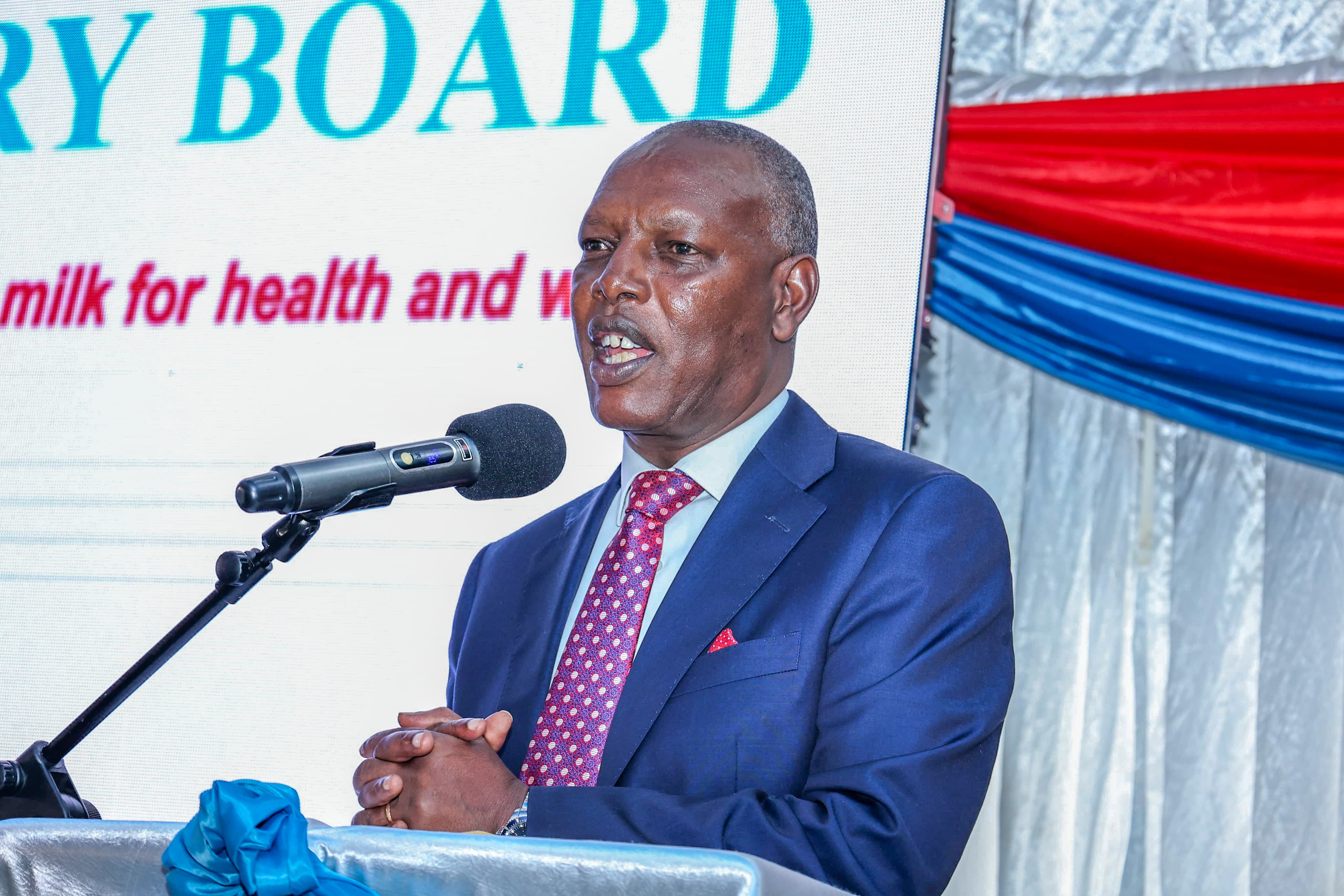
Agriculture and Livestock Development Cabinet Secretary (CS) Dr. Andrew Karanja speaking at the Kenya Dairy Board (KDB) head office during the launch of the cost of Milk Production Study Report (2024). Photo by Gladys Njoka.
He called on stakeholders, including farmers, cooperatives, processors and private investors to leverage the Government’s public land leasing program for large-scale production and distribution of quality fodder saying that improved feeding strategies will greatly enhance productivity.
“Notably, average milk productivity per cow has risen from 7.9 liters in 2020 to 9.3 kilograms in 2023. While there’s still a long way to reach global benchmarks like Israel’s 40 liters per cow per day, sustained efforts and effective strategies can drive significant progress,” he said.
Dr. Karanja appreciated the industry’s effort to maintain high producer prices, averaging Sh46 per liter over the past year saying that this falls below the Government’s recommended Sh50 per liter.
KDB Managing Director (MD) Margaret Kibogy said there has been an increase in the number of farmers who sell their milk to cooperatives and they will be intervening to look at the deductions by the cooperatives to ensure that more money goes to the farmers.
Kibogy said the number of cooperatives has increased from 600 to the current around 700 across the country which means farmers are getting more organized and this will help improve on quality. “Increased production of quality milk will enable us to implement the quality-based payment systems since we will be able to track and monitor the quality and safety of the milk through our laboratory,” said Kibogy.
She explained that out of the one billion liters of milk processed annually, 85 per cent goes to liquid products, that is Ultra-High-Temperature (UHT) and pasteurized milk, but on the high value products like cheese, butter and ghee the production is still very low.
“Currently we are not able to meet the local demand for the high value dairy products and we are looking at ways of in creasing production which will help us even meet the export demands,” said the MD.
Kibogy allayed any fears that as the rainy season kicks in and there is increased milk production, farmers will not be pouring their milk due to overproduction since the country has enough in stalled capacity to process the additional milk.