
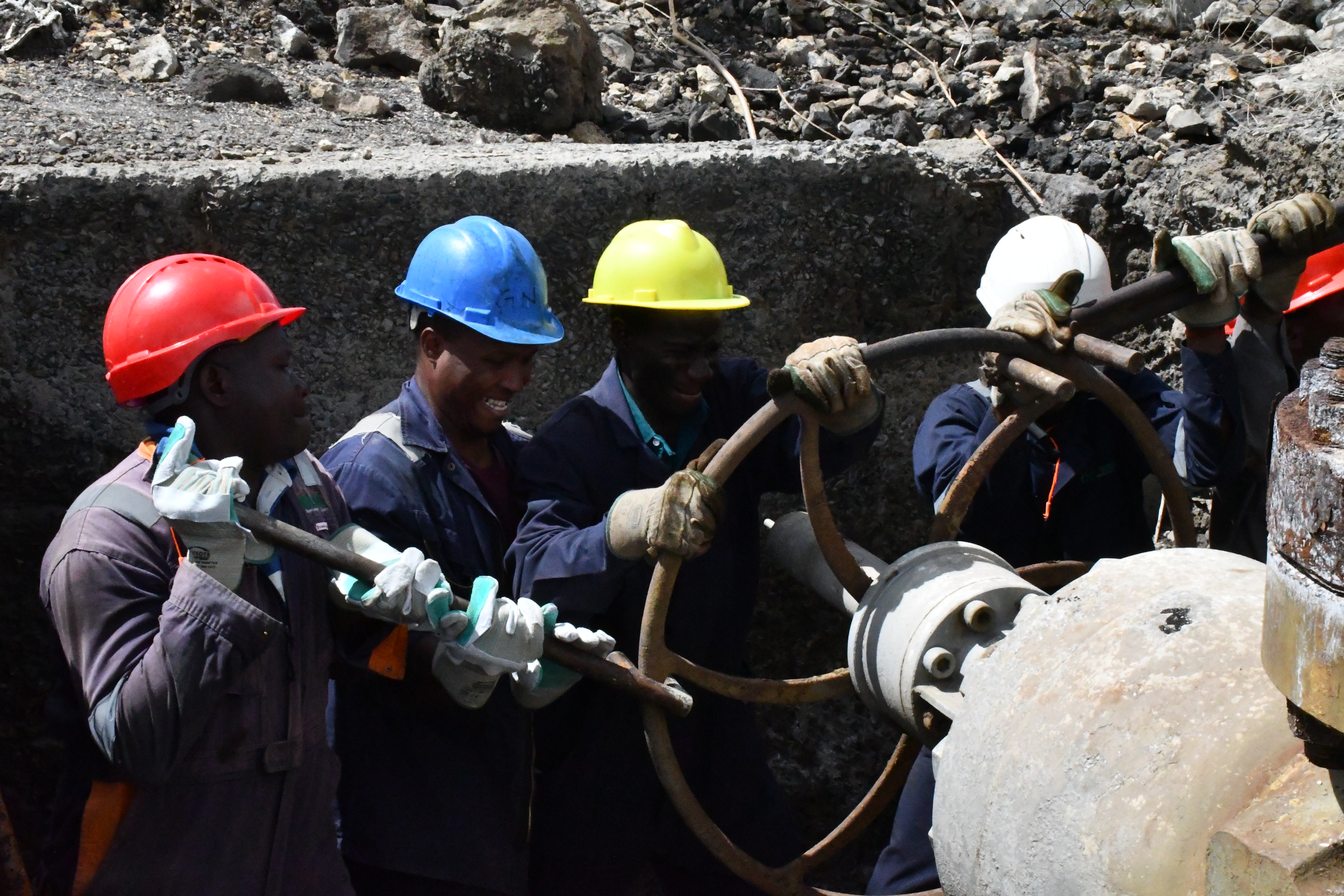
Breakthrough as GDC strikes steam at Baringo Geothermal project
Esther Mwangi and Dennis Rasto-KNA
The Geothermal Development Company (GDC) has struck viable steam at the Silali, marking a major milestone in renewable energy in Kenya.
The field will discharge 22 megawatts of steam. Silali is part of three fields including Korosi and Paka which are part of the Baringo- Silali -Paka Geothermal Project where GDC has been drilling wells for the past seven years.
GDC Managing Director and Chief Executive Officer Paul Ngugi said the first phase of the Baringo-Silali-Paka project targets to develop 300MW spread in three geothermal areas of Korosi, Paka and Silali with each of the fields producing 100MW of power.
He said the success at the Silali field was a major boost in the State corporation’s quest to provide Kenya with affordable and reliable energy adding that the first viable well at the Baringo-Silali-Paka Geothermal project was struck at the Paka field in 2020.
“The viability of the Silali geothermal field will usher Kenya into an age of vibrant geothermal energy,” the MD assured.
While admitting that the Silali field was a very productive area, the MD argued that having one well discharging steam at 22MW was equivalent to drilling about four wells that discharge at 5MW, adding that the GDC company would make huge savings considering that drilling a well costs Sh700 million.
In an interview with KNA, Ngugi said GDC is committed to ensuring timely delivery of renewable energy projects that will greatly support the country’s development vision and plans.
The Director said the Paka field where most of the work has been done was slated to start production of the first 100MW by 2028.
He explained that GDC had drilled for steam and next is power plant construction, adding that the company is doing a feasibility study and thereafter scout for investors.
He said the project would be operational in the next three years feeding power on the national grid.
Noting that all major economies thrive because of access to abundant energy, the MD was happy that geothermal would power Kenya into a vibrant future of great industrial and social development.
At Baringo-Silali -Paka, Mr Ngugi disclosed that GDC had harnessed 75MW of geothermal steam and that the company is targeting to have a 105 MW power plant at Paka by 2027.
Similarly, GDC had started to open the Suswa field in Naivasha, Ngugi added.
He said power producers will be competitively selected to build power plants at the Baringo-Silali-Paka geothermal fields, which are then expected to start electricity production by 2028.
This is as Kenya eyes increased electricity production from geothermal to reduce reliance on hydro power that is prone to weather shocks as well as displace costly thermal power plants.
The Baringo-Silali fields, which are outside the traditional geothermal fields of Olkaria, have capacity to produce an estimated 3,000 megawatts, making them an appealing alternative for the country that now needs to balance between availing power to the grid and making it affordable.
While geothermal resources in Kenya has an estimated geothermal potential of 10,000MW, the country has only exploited about 950MW to date.
Of this, about 800MW is generated at power plants built by Kenya Electricity Generating Company (KenGen) while the balance is by Independent Power Producers (IPPs) Orpower that produces 150MW at its plants at Olkaria, and the recently launched 35MW plant by Sosian Energy at Menengai Geothermal Project.
Mr Ngugi indicated that the IPPs that would put up power plants at the Baringo-Silali fields would sell electricity to Kenya Power at between Sh8 and Sh10 (six and seven US cents) per unit.